Research
Metamorphic and Tectonic History of the Manhattan Prong
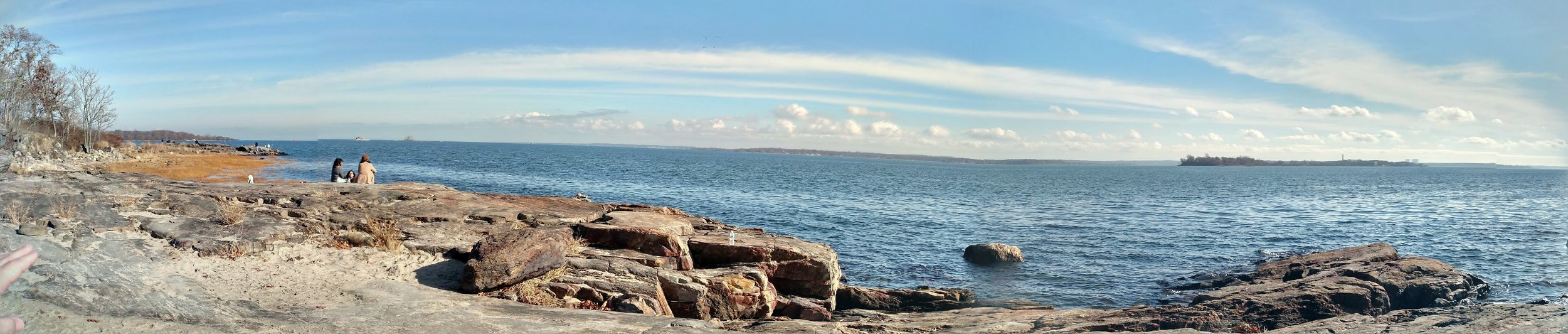
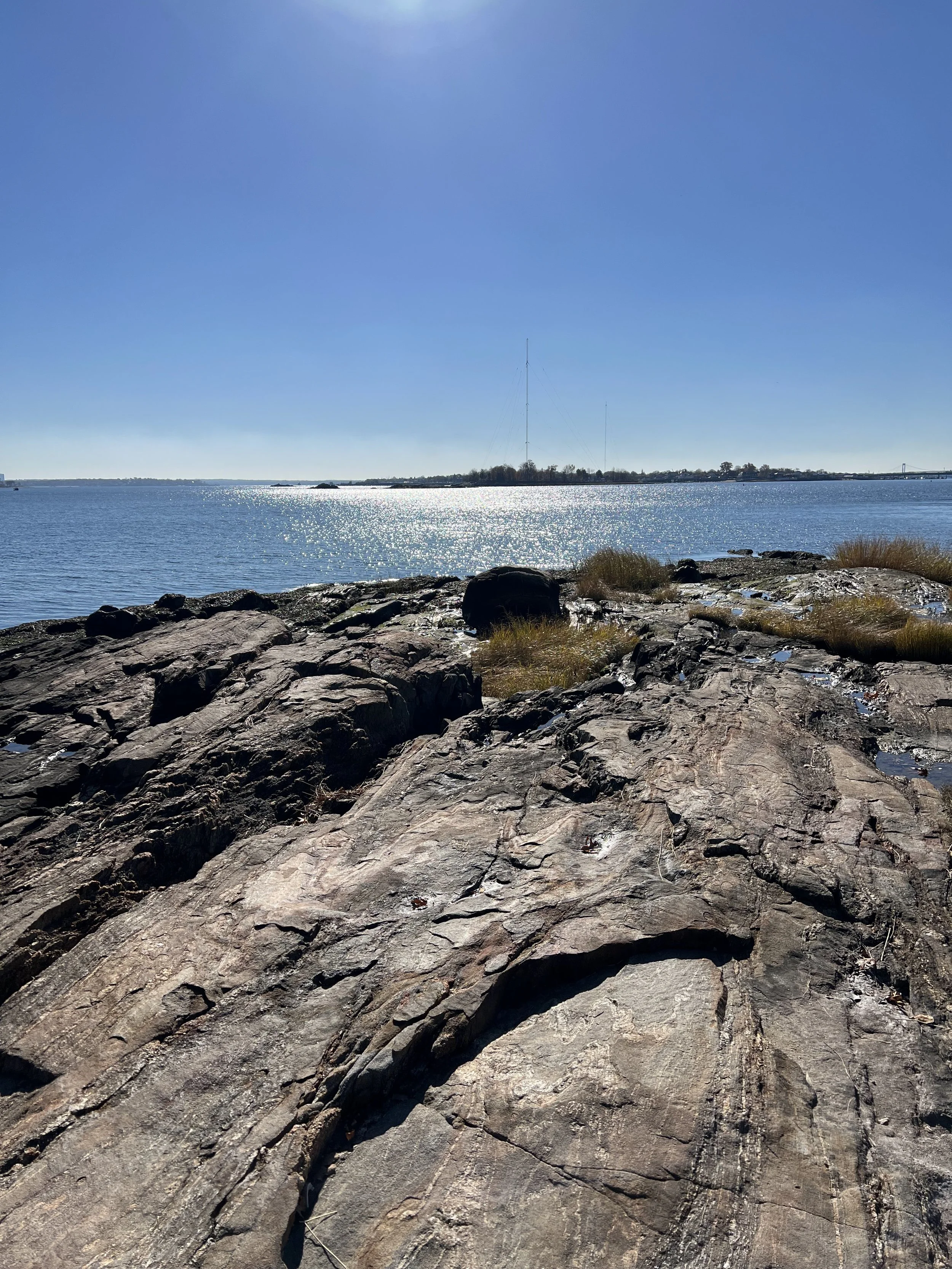
New York City is part of the physiographic region known as the Manhattan Prong, which is bounded by Long Island to the southeast, the Mesozoic Newark Basin to the west, and the Grenvillian Hudson Highlands to the north and northwest. The Manhattan Prong marks the transition from the Northern to Southern Appalachians, with map patterns and tectonic interpretations markedly changing on either side. While these rocks are thought to record a complex polymetamorphic history, there is a paucity of modern metamorphic data linking this region to either the north or south. Thus, constraining the tectonic and geochemical evolution of the metamorphic bedrock underlying the Prong provides key insights into the evolution of a major portion of the Appalachian Mountains. The Manhattan Prong also offers an exciting natural lab through which we can test the ability of both major and accessory phase petrochronology to record high-grade polymetamorphic histories.
This project synthesizes garnet Sm-Nd and Lu-Hf geochronology, monazite in situ U-Pb dating, thermodynamic modeling, and garnet diffusion modeling to constrain this history. We are working closely with the TeMPO lab at Johns Hopkins University, the Boston College Center for Isotope Geochemistry, the GeMS lab at the University of South Carolina, the Roberts Lab at Hamilton College, and the American Museum of Natural History in New York City. Our most recent work has shown both that accessory phase and major phase petrochronology can be decoupled as a result of “Barrovian” polymetamorphism, and that the Manhattan Prong records Devonian , rather than Cambro-Ordovician, tectonism.
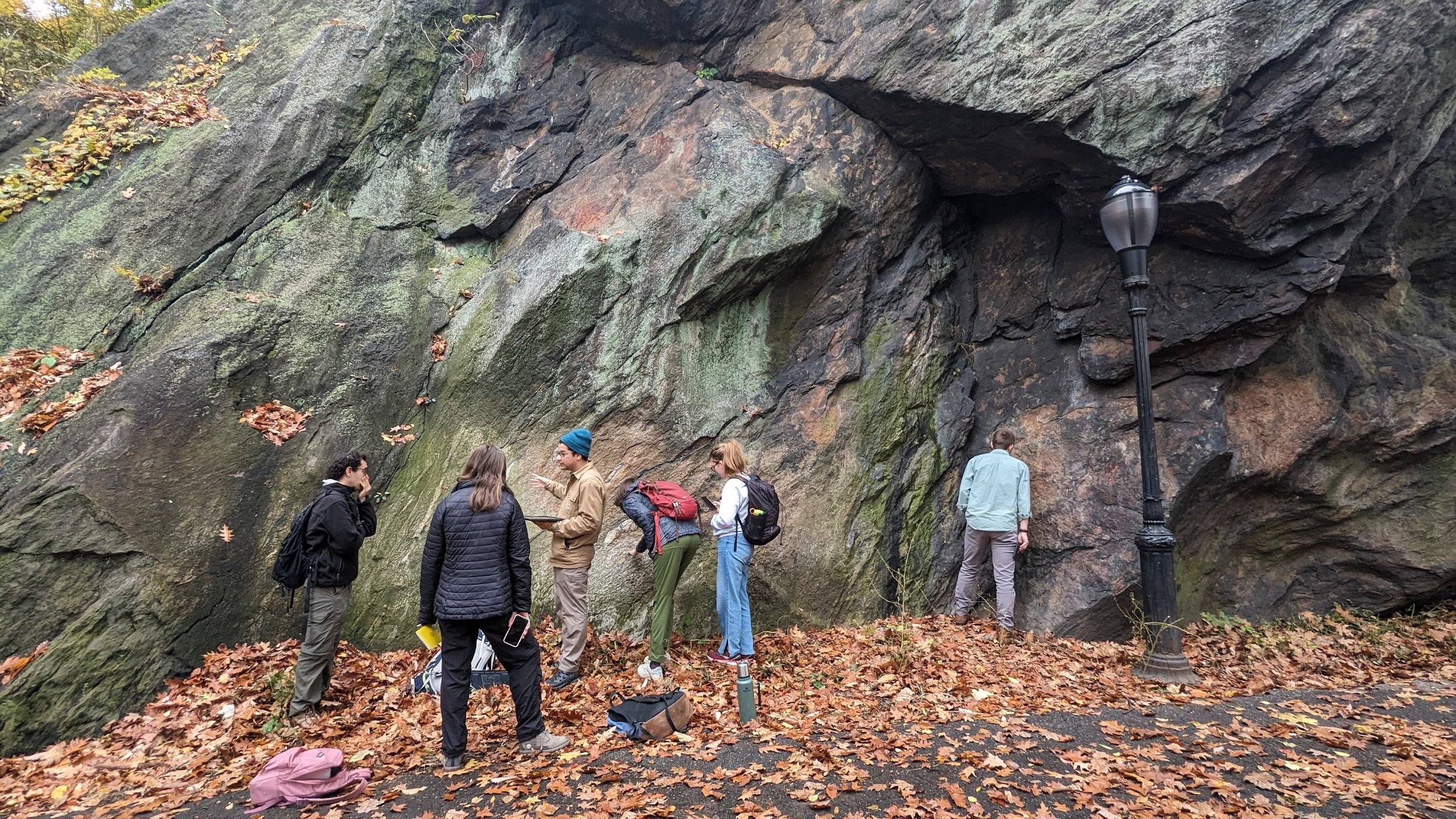
The photo on the left is an example of the high-grade gneisses you can find in the Bronx!
Related Publications and Abstracts
Castro, A. E., Viete, D. R., Walker, S., Jaret, S. J., Brunet, I., Morin, K., Brenner, D. C., Roy, S., Baxter, E. F., Wolfe, O. M., & Thomas, J. (2025). Decoupled monazite and garnet petrochronology reveals short-duration, high-temperature Acadian metamorphism in the Manhattan Schist, New York City, USA. Geology. https://doi.org/10.1130/G53777.1
Castro, A.E., Jaret, S.J., Roberts, N.M., Weed, R.C., Morin, K.D., & Brunet, I.M. (2025) Tectonometamorphic Evolution of Northern Manhattan: Constraints on (Neo)Acadian Tectonism, New England Intercollegiate Geological Conference Guidebook.
Tectonic History of the Nashoba Terrane in Central MA
The metamorphic bedrock exposed in the Nashoba terrane of East-Central Massachusetts records a complex history of deformation and metamorphism associated with the subduction of the Iapetus Ocean and collision of Avalonia with the composite Laurentian margin during the Acadian orogeny. Although the structural history of the terrane has been well studied, its pressure-temperature (P-T) history is less constrained. Accurately determining P–T histories provides key constraints on orogenic processes, such as the depth of rock burial, the evolution of the geothermal gradient, and rates of exhumation. In our lab, we apply a range of field, lab, and modeling based petrologic techniques to try and unravel this missing bit of New England tectonic history!
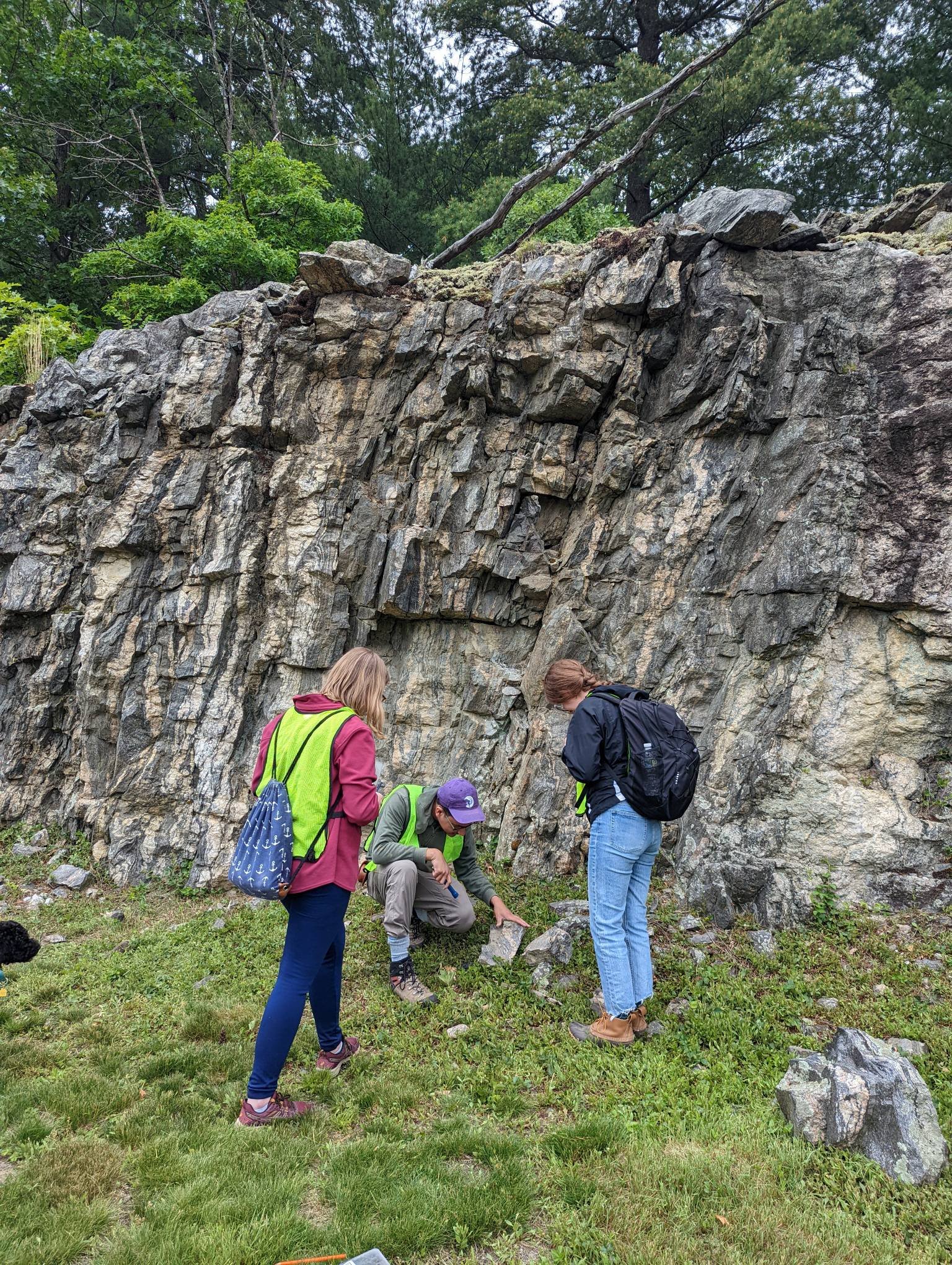
The image on the right is a photo of Emlynn Merrill ‘25 (L) and Katherine Morin ‘24 (R) investigating an outcrop of folded migmatite in the Nashoba Terrane. They conducted preliminary petrographic analysis and phase equilibria modeling as part of their summer reseach projects. Photo credit to Jannitta Yao ‘21.
Related Publications and Abstracts
Yao, J. T., Castro, A. E., Roberts, N. M., Wolfe, O. M., Brunet, I. M., & Vasey, D. A. (2023). Phase Equilibria Evidence for Intermediate P/T Metamorphism in the Nashoba Terrane and Implications for Acadian Tectonics in Ganderia. Lithosphere, 2023(1).
Jannitta T. Yao, Adrian E. Castro, Nicolas M. Roberts, Oliver M. Wolfe, Isabella M. Brunet, Dylan A. Vasey; Phase Equilibria Evidence for Intermediate P/T Metamorphism in the Nashoba Terrane and Implications for Acadian Tectonics in Ganderia. Lithosphere 2023;; 2023 (1): lithosphere_2023_105. doi: https://doi.org/10.2113/2023/lithosphere_2023_105
*Yao, J., *Brunet, I., Castro, A.E., Wolfe, O.M., Kuiper, Y., Hepburn, & C.J., 2022 , Synthesizing petrographic analysis and modern thermodynamic modeling to determine the P–T conditions of metamorphism in the Nashoba Terrane, East-Central MA, Geological Society of America, Abstracts with Programs., Vol 54, No. 3, https://doi.org/10.1130/abs/2022NE-374827
Castro, A.E., *Yao, J., Wolfe, O.M., 2022 Some like it hot: Reevaluating the extent of anatexis in the Nashoba Terrane, East-Central Massachusetts , Geological Society of America, Abstracts with Programs, Vol 54, No. 3, https://doi.org/10.1130/abs/2022NE-375400
Castro, A.C., *Yao, J., Wolfe, O.M., George, F.R., Vasey, D.A., Cryptic Early “Barrovian” Metamorphism in the Trailing Edge of Ganderia: Evidence from Aluminosilicate Reaction Textures, Garnet Trace Element Zoning and Phase Equilibria Modeling, 2022 Goldschmidt Meeting
Yao, J., Castro, A., Castro, A., Brunet, I., Brunet, I., Roberts, N., Roberts, N., Wolfe, O. M., Wolfe, O. M., Kuiper, Y. D., Kuiper, Y. D., Hepburn, J. C., & Hepburn, J. C., 2022, “Barrovian” metamorphism in the Nashoba terrane: evidence from combined phase equilibria modeling, geothermobarometry, and petrographic analysis. Geological Society of America Abstracts with Programs. Vol 54, No. 5, https://doi.org/10.1130/abs/2022AM-381261
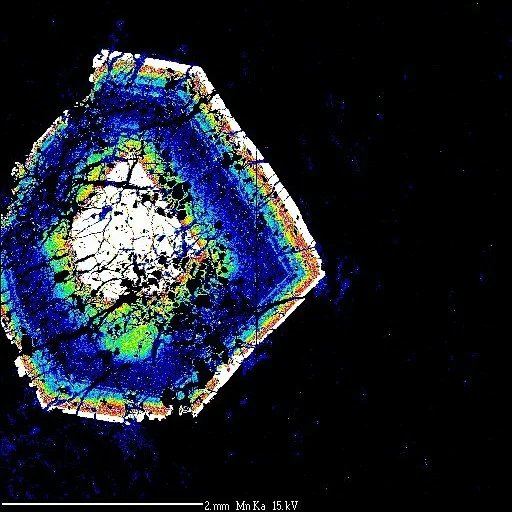
Constraining the P–T Conditions of Devolatilization During Cycladic Subduction
The nucleation and growth of garnet are important fluid fluxes during the subduction of oceanic crust and sediment. I use Raman inclusion barometry, trace element thermometry, thermodynamic modeling, and kinetic modeling to accurately constrain the pressure-temperature conditions of garnet nucleation and growth.
The image on the right is a concentration map showing the relative concentration of Mn in a garnet from Syros, Greece. Hotter colors indicate high concentration while cooler colors indicate lower concentration. The map was taken on the SX-50 at the Rensselaer Polytechnic Institute.
Related Publications and Abstracts
Castro, A.E, and Spear, F., 2016, Reaction Overstepping and Reevaluation of the Peak P-T Conditions of the Blueschist unit Sifnos, Greece: Implications for the Cyclades Subduction Zone. International Geology Review.
Kohn, M.J., Castro, A.E., Karswell, B.S., Ranero, C., Spear, F.S., 2018, Shear heating reconciles thermal models with the metamorphic rock record of subduction. Proceedings of the National Academy of the Sciences.
Castro, A. E., Frank S. Spear, and J.T. Cheney, 2016 Application of epidote and quartz inclusion Raman barometry: reevaluation of the PT conditions of garnet bearing blueschists from Sifnos, Greece. Geological Society of America Annual Meeting
Castro, A.E., and Frank S. Spear, 2017, Lawsonite revisited: insights from integrated QuiG Raman barometry, trace element thermometry, and OS thermodynamic modelling of garnet inclusions in lawsonite pseudomorphs from Syros, Greece. Geological Society of America Annual Meeting
Castro, A.E., Frank S. Spear, and M.J. Kohn., 2017, Shear heating and metamorphism in subduction zones, 2. The seismic-aseismic transition at c. 50 km depth. American Geophysical Union Fall Meeting
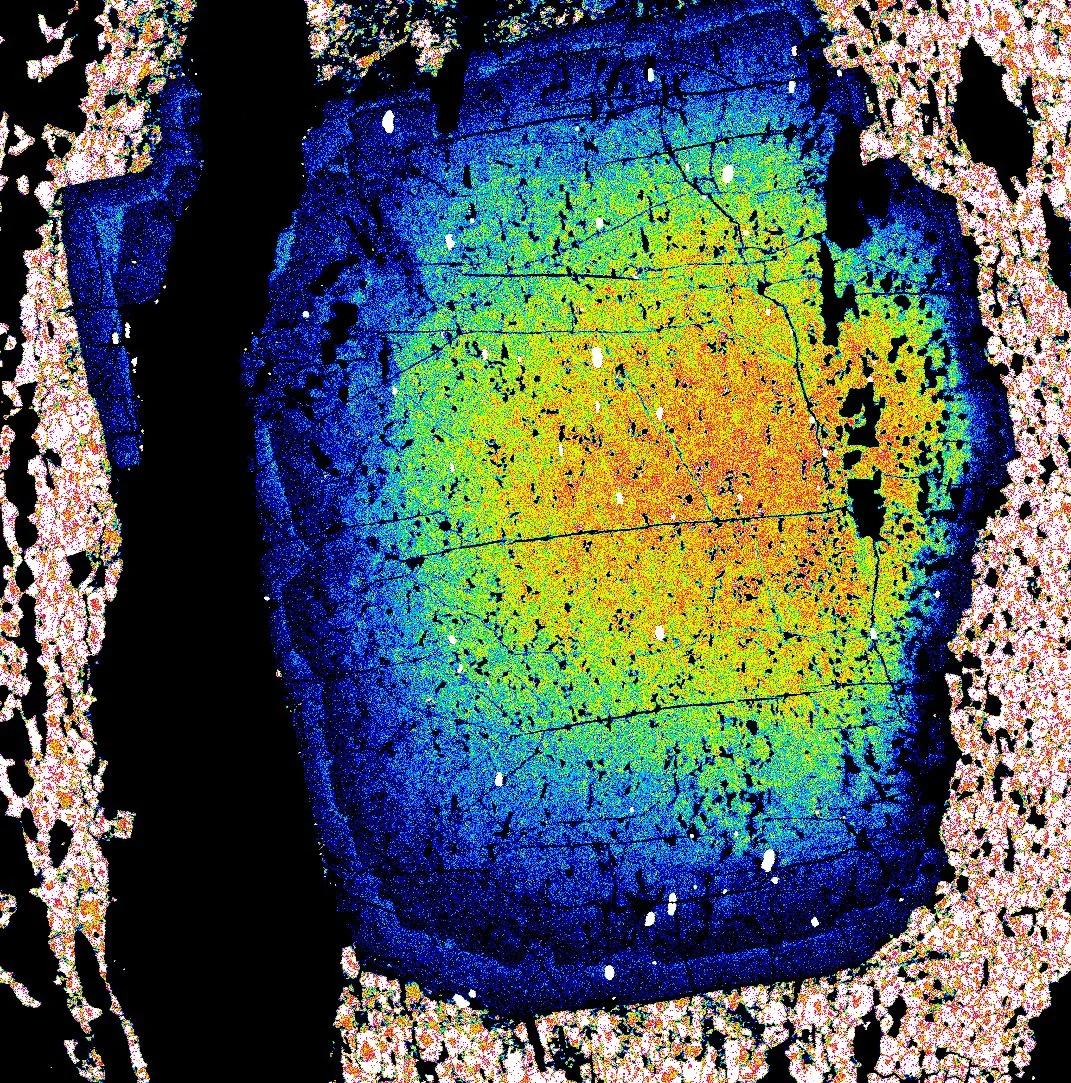
P–T Conditions of Garnet Nucleation and Deformation in the Picuris Mtns
My postdoctoral work is focused on determining the P–T conditions of garnet formation and deformation in stretched pebble conglomerates from the Picuris Mtns, NM. This work allows me to combine more traditional petrologic techniques (e.g. geothermobarometry) with non-traditional tools (e.g. Raman inclusion barometry, trace element thermometry) and lets me spend a lot of time on the wonderful Cameca SX-100 microprobe at the UW Madison!
The image on the right is a concentration map showing the relative concentration of Ca in a garnet from a stretched pebble conglomerate in the Picuris Mountains. Hotter colors indicate high concentration while cooler colors indicate lower concentration. The map was captured on the SX-100 at the UW Madison.